

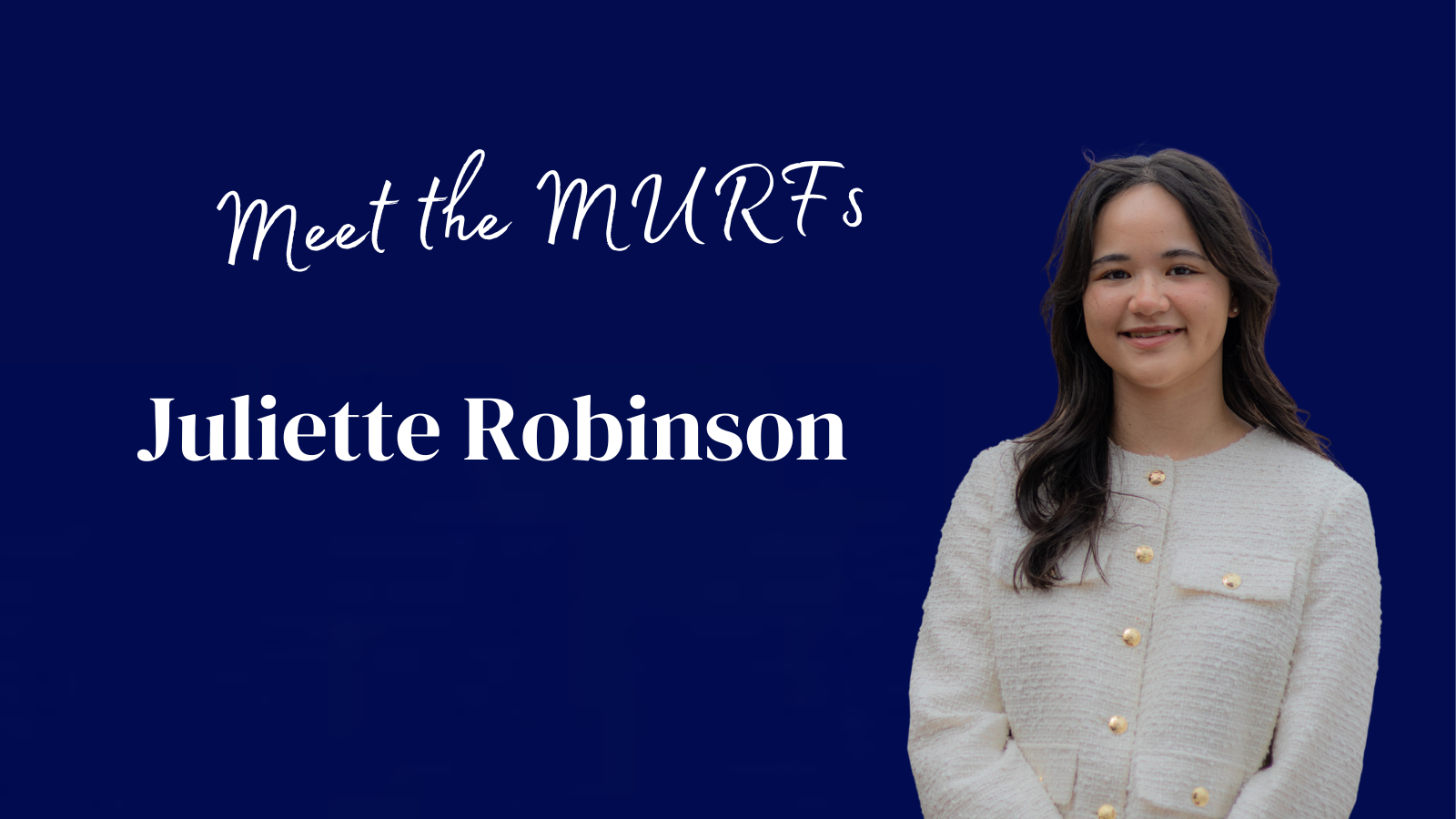
Meet the MURFs: Juliette Robinson
Juliette Robinson is a member of the Class of 2028 in the School of Foreign Service. She plans to major in international politics and pursue a certificate in international business diplomacy. As a MURF, Juliette conducts research on international trade policy and law with Professor Marc Busch. Having grown up in both Little Rock, AR and Hong Kong, Juliette is particularly interested in how trade interests diverge and align across different economies. Beyond her research, Juliette serves as an official student social media ambassador through Georgetown Storytellers, is a project manager with Georgetown Global Consulting, and captains the Georgetown Women’s Rugby team.
Tell us about a research project you worked on as a MURF
As a MURF, I’ve had the opportunity to work on a wide range of projects, but one particularly engaging project has focused on using a large-language model (LLM) to analyse changing sentiment in U.S. National Trade Estimates (NTEs) related to sanitary and phytosanitary (SPS) provisions. My work has involved coding key phrases to feed into the LLM, as well as contributing to a broader literature review. Through this project, I’ve been able to combine legal analysis with computational methods, which has pushed me to think more carefully about how qualitative legal language can be systematically analysed at scale.
What advice would you give to students considering the MURF program?
Accept that you won’t know what your argument is from the beginning. Let your project narrow in scope organically, and don’t try to force a narrative too early: let the data guide you. The process can be difficult and uncomfortable, but that uncertainty is productive. Some of the most interesting research questions emerge only after you’ve spent time sitting with the material and noticing patterns that weren’t obvious at first.
What is one memory that stands out to you from your participation in the MURF program so far?
What stands out most to me is the Mortara community itself. Rather than a single moment, it’s the accumulation of many experiences: from the MURF Symposium, where I heard older MURFs present their research and received personal advice, to the many meals at Mortara filled with both rigorous intellectual discussions and decidedly less-intellectual ones. Events like the Mortara Centre’s 25th Anniversary or Christmas Party further reinforced how intentional the community is about bringing people together across disciplines and stages of academic life.
What is something surprising about you that you’d like people to know?
One thing that may surprise people is that research doesn’t have to be done in seclusion. Mortara is a space where undergraduates, graduate students, and professors regularly intersect, which has made research feel collaborative rather than isolating. This collaboration happens both formally and informally. During Mortara research seminars, for example, you get to watch experts openly exchange ideas and give feedback to one another. Just as much exchange happens before and after these events through conversations over light refreshments, which has fundamentally shaped how I think about research as a shared, evolving process.