

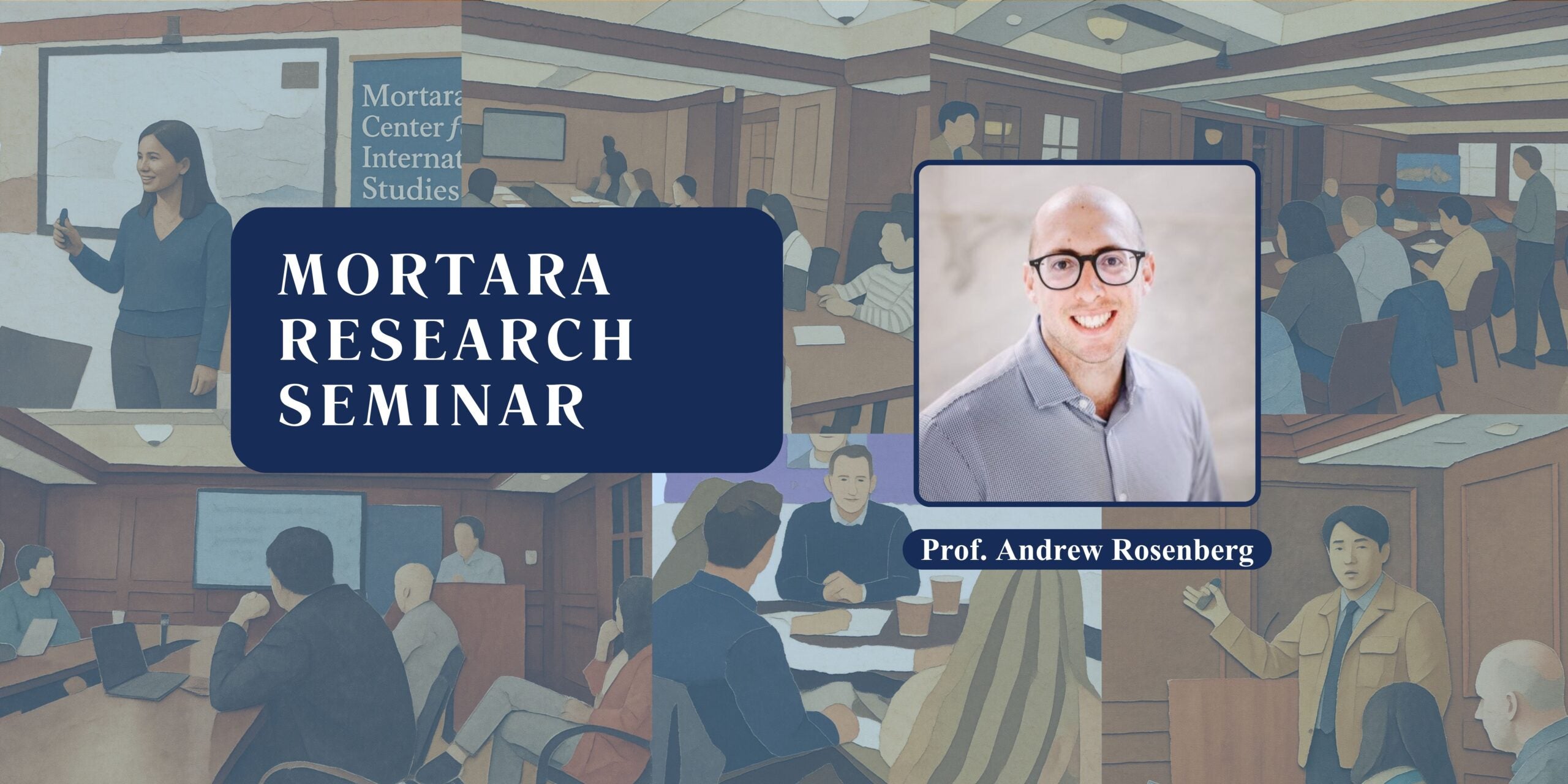
Mortara Research Seminar – A Conversation with Professor Andrew Rosenberg
By Anna O’Sullivan
On Monday, September 21, 2026, the Mortara Center for International Studies had the privilege of welcoming Professor Andrew Rosenberg of the University of Florida to discuss an upcoming book project at the weekly Mortara Research Seminar. Rosenberg’s presentation, titled, “Hierarchies of Worth: Race and the Distribution of Concern in World Politics,” draws on a chapter from a book manuscript currently under review at Cambridge University Press. The project began as a narrower argument about refugee and asylum policy before growing into a broader study of international racial hierarchy.
Professor Rosenberg is Associate Professor and Director of Graduate Studies in the Department of Political Science at the University of Florida. His research explores race and racism in international politics, with work appearing in the American Journal of Political Science, the Journal of Politics, International Studies Quarterly, and Political Analysis. His first book, “Undesirable Immigrants: Why Racism Persists in International Migration,” was published in August 2022 and received the 2023 Best Book Award from the American Political Science Association’s Race, Ethnicity, and Politics section. He received his PhD from the Ohio State University, and holds an MSc in International Relations (Research) from the London School of Economics and a BA from Johns Hopkins University.
Rosenberg opened his discussion with a puzzle: India is often considered a rising power, yet its passport ranked 82nd in the January 2026 Henley Passport Index, a comparatively weak standing. This disconnect, he argued, points toward a central question: whose claims matter enough for governments to bear costs? Foreign populations, he contends, carry unequal political weight in international politics, forming what he calls a “hierarchy of worth,” defined as any pattern of super- and subordination in countries’ positions across international politics. He argued that international structure includes whose welfare carries weight, a distribution of concern that racial hierarchies help organize and that shapes which costs governments are willing to bear. To measure this structure empirically, Rosenberg examined eight domains of international politics and combined Bayesian measurements within a dynamic hierarchical model to show that gaps between countries can widen even as their relative rankings remain largely stable. Racial patterns recurred across the historical record, he found, but their form varied by domain and relationship, meaning there is not one single racial hierarchy, but multiple that govern international life.
Rosenberg closed by connecting this chapter to the book’s broader argument: unequal concern for foreign populations helps explain which costs governments choose to bear. The Mortara Research Seminar thanks Professor Rosenberg for a rigorous and wide-ranging talk.
The Mortara Research Seminar is a forum for sharing and discussing new research on topics of Comparative Politics and International Relations. The seminar is intended for faculty, researchers, and graduate students from the Government Department and the School of Foreign Service. You can learn more here.