

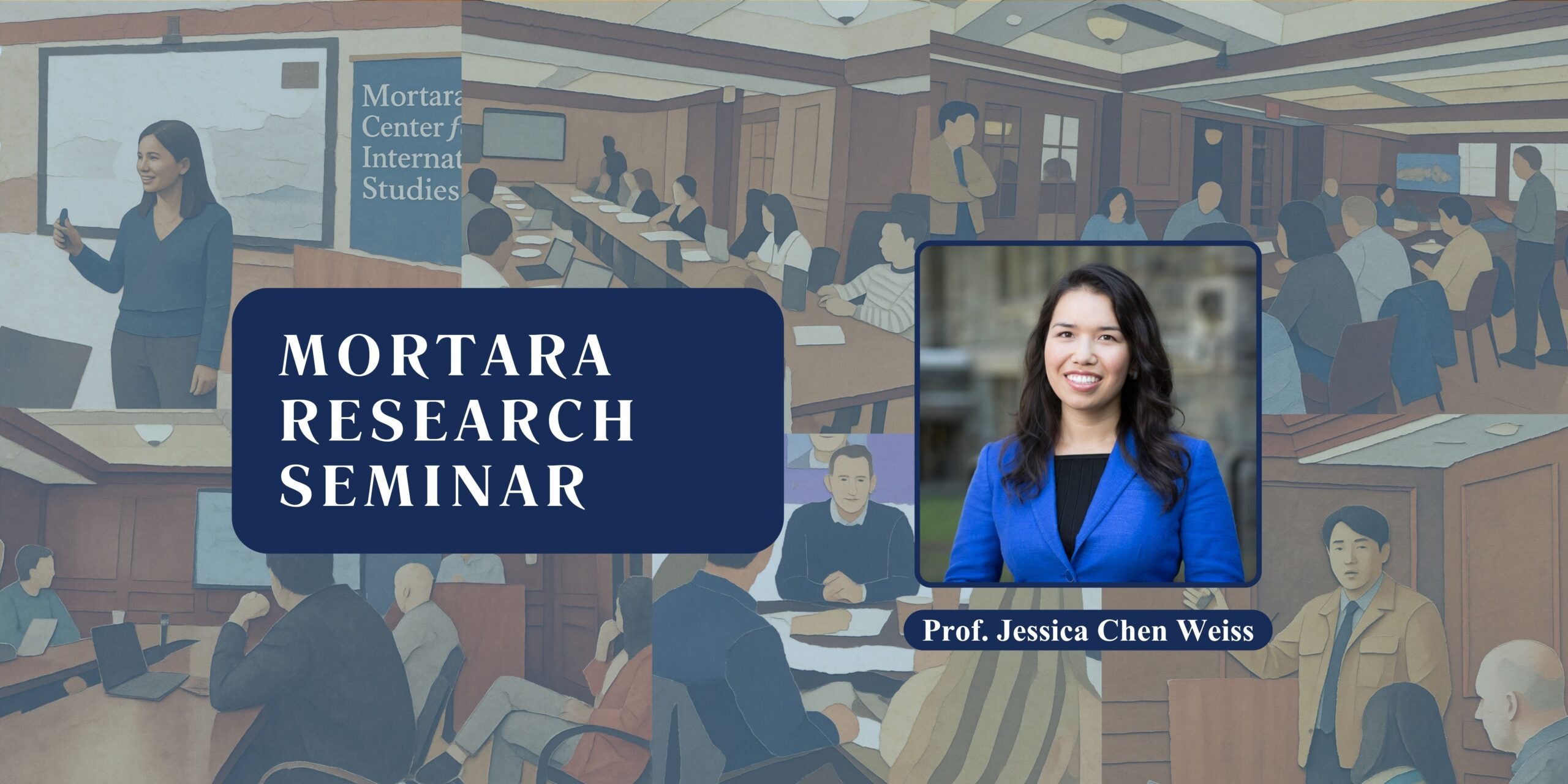
Mortara Research Seminar – A Conversation with Professor Jessica Chen Weiss
By Anna O’Sullivan
On Monday, September 14, 2026, the Mortara Center for International Studies had the distinct privilege of welcoming Professor Jessica Chen Weiss of Johns Hopkins University to speak at the weekly Mortara Research Seminar. Professor Weiss is the David M. Lampton Professor of China Studies at Johns Hopkins University’s School of Advanced International Studies and the inaugural faculty director of the Institute for America, China, and the Future of Global Affairs at SAIS. Her background spans from academia to focused policy work, having served as senior advisor to the Secretary’s Policy Planning Staff at the U.S. State Department on a Council on Foreign Relations Fellowship for Tenured International Relations Scholars (IAF-TIRS). Professor Weiss specializes in great-power competition and U.S. relations with China, producing important research that has been published in journals such as International Organization, China Quarterly, International Studies Quarterly, Journal of Conflict Resolution, Security Studies, Journal of Contemporary China, and Review of International Political Economy. At the Mortara Center, Professor Weiss spoke on the use of the term “strategic competition,” and whether it may be problematic.
Professor Weiss’s talk examined how “strategic competition” has become the dominant framework for U.S. policy toward China, despite resting on assumptions the field rarely interrogates: that states are stable units with coherent interests shaped by their position in the international system, and that “winning” is itself a coherent goal. She argued the term is fundamentally underspecified, concealing competing visions of what success would actually require, whether the preservation of global hegemony, defence of a rules-based liberal order, or maintenance of technological dominance. This ambiguity is not incidental, she suggested, but produces what she called the poverty of strategic competition: a framing that flattens disagreement into a single contest and manufactures zero-sum pressure even where American and Chinese interests may in fact align, presenting the two countries’ interests as more at odds than they truly are.
Professor Weiss situated this critique within a longer historical debate, revisiting the Thucydides Trap and the Crowe Memorandum as frequently cited but often overused touchstones representing only one side of an unsettled argument about great power rivalry. Turning to current policy, she characterised many Trump administration actions toward China as expressions of ideological commitment and domestic political calculation rather than logical responses to competitive pressure, pointing to shifting American public attitudes as part of that dynamic.
Rather than abandoning the language of competition altogether, Professor Weiss called for greater precision, floating alternative framings such as managed coexistence while acknowledging that no single construct is likely to inevitably replace strategic competition. She closed by observing that spirals of mistrust, while genuinely constraining, can also open opportunities for reassessment and stabilisation, and raised the deeper, constructivist question of whether labelling China a strategic competitor helps produce the very rivalry the term claims only to describe. The Mortara Center is grateful for Professor Weiss’s rigorous and timely reflections, and looks forward to further scholarship that sharpens our understanding of great power competition and its discontents.
The Mortara Research Seminar is a forum for sharing and discussing new research on topics of Comparative Politics and International Relations. The seminar is intended for faculty, researchers, and graduate students from the Government Department and the School of Foreign Service. You can learn more here.